
SkyGrid’s Dr. Joseph Rios recently joined EUROCONTROL, a pan-European organization dedicated to supporting European aviation, to discuss how automated traffic management services can enable Advanced Air Mobility (AAM) operations at scale. The conversation covered what makes AAM fundamentally different from today’s aviation, why new flight rules are needed, and how an Automated Traffic Management System (ATMS) can support safe, efficient, and scalable operations in a new class of airspace. AAM cannot scale without automation, and the aircraft, flight rules, and traffic management systems all have to advance together.
Watch the full webinar recording here.
What Makes Advanced Air Mobility Different
Helicopter operations today take place at relatively low tempos, are gas powered, and flown by onboard pilots. Future AAM operations will look different, with battery-powered electric aircraft operating at higher tempos, some autonomously with no pilot onboard.
Higher tempos mean air traffic controller workload will increase with the number of new aircraft introduced. With the current strained system and controllers already facing workload limits, this model of human-to-human coordination is unable to scale. AAM aircraft will also need airspace structures and routes that allow them to operate independently of commercial jets at major airports, along with new planning systems to achieve predictable turnaround times and schedules.
Electric aircraft cannot fly as long as traditional aircraft, making Air Traffic Control (ATC) delays particularly costly. Managing air traffic using more predictable trajectories and schedules becomes a requirement, and because there is no pilot onboard to see and avoid other traffic or communicate with ATC, autonomous operations require new aircraft systems, data, flight rules, and communication procedures entirely.
Why New Flight Rules are Needed
Today’s two operating paradigms, VFR and IFR, both assume a pilot is onboard the aircraft. Under VFR, pilots rely on see-and-avoid methods to remain clear of hazards and other traffic. Under IFR, pilots rely on ATC-provided services to stay organized and safely separated. Neither framework accounts for the absence of a pilot onboard.
Automated Flight Rules (AFR) are proposed as a third operating paradigm that would complement VFR and IFR and be available to any properly equipped aircraft, not just new autonomous ones. Under AFR, aircraft rely on automation to remain efficiently organized and safely separated, removing the assumption that a pilot is onboard. Learn more in our Concept of Operations for Automated Flight Rules.
AFR introduces higher levels of automation for organizing and separating traffic, achieved through new onboard and ground-based systems. Automated traffic management would scale AAM traffic without significant increases in controller workload. Digital communications would manage crewed and uncrewed operations through system-to-system exchanges, and ATC would take on a strategic role focused on high-level decisions about airspace availability, capacity, and configuration rather than routine tactical instructions.
Automated Traffic Management in Class X Airspace
Our Automated Flight Rules White Paper, developed with Wisk, proposes a new airspace structure, Class X, designed to support high-density AAM operations. In Class X airspace, an ATMS is responsible for keeping aircraft sequenced and safely separated. SkyGrid is developing this ATMS, along with the broader concepts of operations that will bring this future within reach.
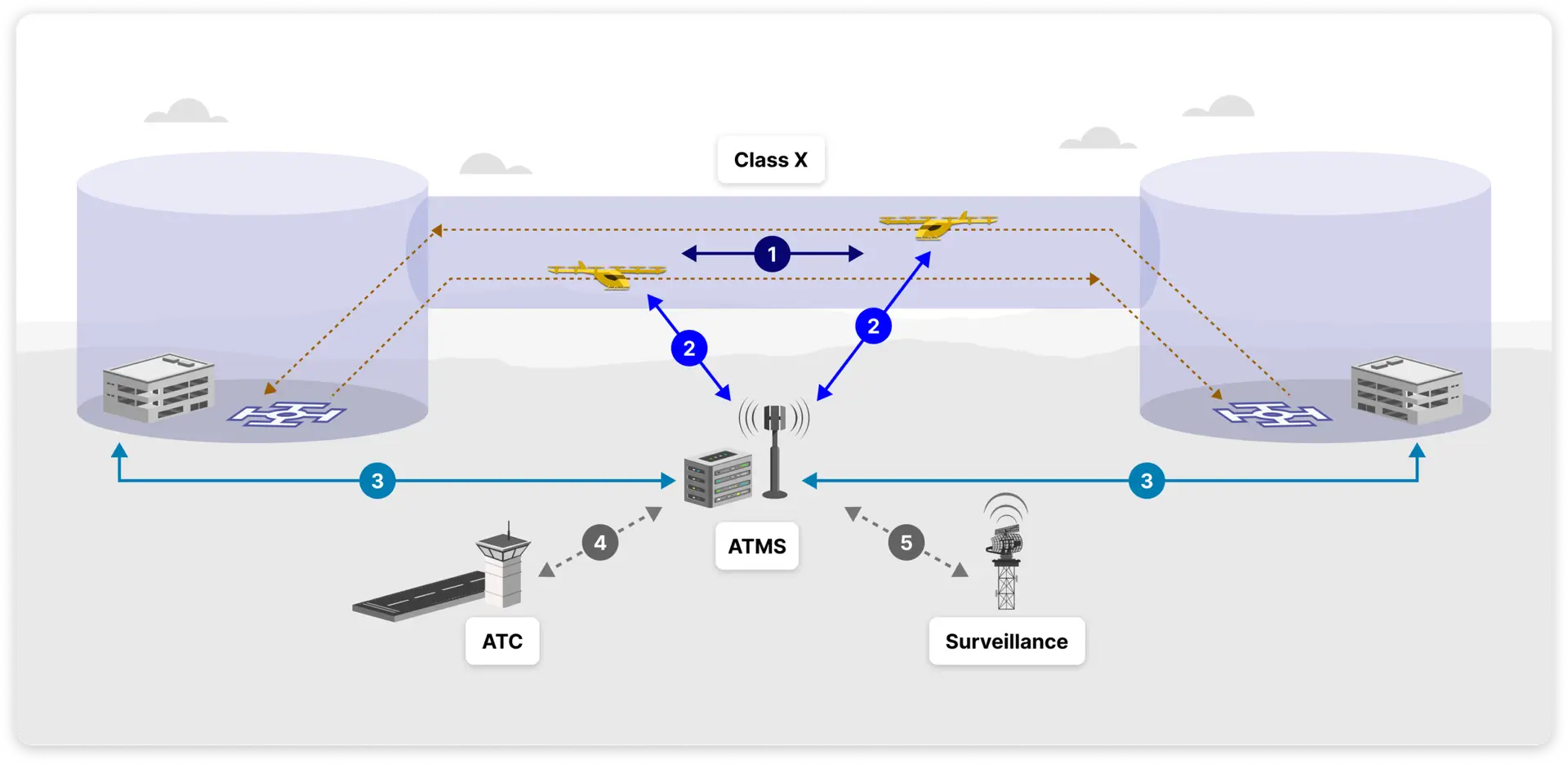
Notional illustration of operations in Class X airspace and supporting systems
Unlike conventional controlled airspace, the digital communications in this airspace will be issued by automated systems. The ATMS will leverage high-assurance surveillance data to exercise its conflict management functions and exchange data with ATC to coordinate handoffs, share flight data, and receive inputs on things like airport capacity and traffic flow levels, ensuring all parts of the airspace remain integrated. SkyGrid is working with the FAA-sponsored Center of Advanced Aviation Technologies (CAAT) to develop and test these capabilities, focusing on cooperative separation to enable more efficient, system-level strategic and tactical deconfliction.
Conflict Management at Scale
The conflict management model in Class X aligns with the ICAO Global Air Traffic Management Operational Concept, and AFR introduces four distinct layers of conflict management.
Strategic conflict management happens during the planning phase, ensuring resources in the airspace are not being overcommitted and that all operators have shared awareness of intent. Demand-capacity balancing determines when takeoff and landing slots are available. Pre-tactical conflict management smooths out any remaining issues in the minutes before departure, with departure metering pre-sequencing traffic at merge points. Tactical conflict management monitors for non-conforming aircraft once airborne, responds to hazards, and manages traffic to keep aircraft safely separated through dynamic rerouting. Collision avoidance serves as the final layer of protection.
Each layer reduces the burden on the layers that follow. Relying solely on collision avoidance would quickly overwhelm the system. Tactical separation provision needs the strategic layer to function properly, and automation across all layers is what makes the whole system precise, certain, and scalable enough to hit industry targets.
The Role of Third-Party Service Providers
Automated traffic management is not a single system built by a single entity. It’s an ecosystem of services, and how those services are structured and distributed is what determines whether the overall system can function reliably at scale.
Not all traffic management services need to be provided by the same entity. A Third-Party Service Provider, like SkyGrid, is a commercial entity that integrates data from the operating environment to deliver actionable information and decision support services to AAM operators, helping facilitate airspace integration of new operations. SkyGrid’s automated traffic management services span the full conflict management stack—from strategic demand-capacity balancing and vertiport scheduling through pre-tactical departure metering and tactical traffic synchronization—enabling operators to fly predictable, efficient trajectories while remaining safely integrated with the broader airspace system.
Some services make sense to federate across multiple providers, while others require centralization under a single authority per airspace class or sector. Separation services, for example, need to be provided by a single entity within any given airspace. Getting this architecture right and knowing which services to federate and which to centralize is foundational to building a low-altitude ecosystem that is both commercially viable and safe enough to earn regulatory trust.