
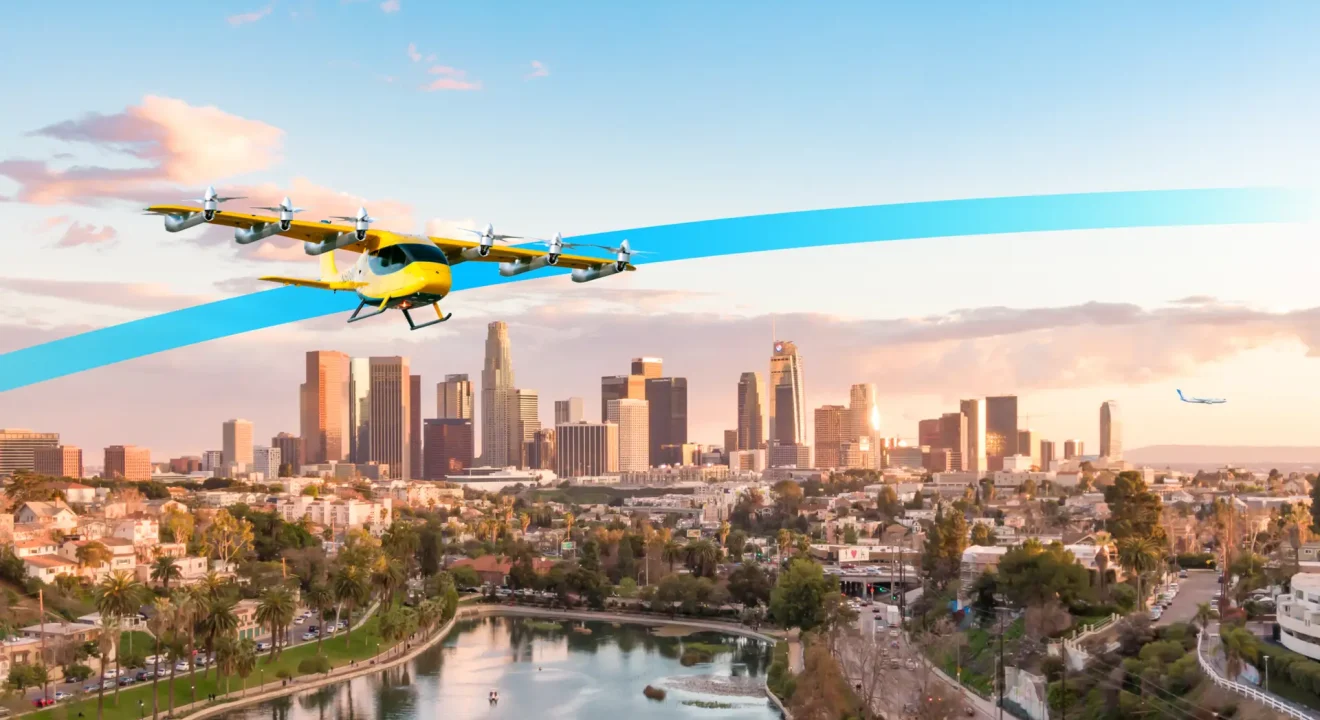
The Urban Air Mobility (UAM) industry is rapidly developing novel passenger-carrying aircraft, but integrating these operations safely into already complex urban airspace poses a significant challenge. Commercial-scale UAM will operate at frequencies comparable to those of operations at major airports. The airspace used by UAM must accommodate a high density of operations, but doing so under today’s flight rules and airspace structures may not be possible without hitting the limits of what the air traffic control (ATC) system can safely accommodate.
SkyGrid and Wisk’s new white paper, Enabling Scalable Urban Air Mobility Through Automated Flight Rules, outlines how Automated Flight Rules (AFR) can support the safe and efficient scaling of low-altitude UAM beyond current airspace constraints through novel automation.
Scaling UAM requires new conflict management automation, new airspace structures where automation safely separates aircraft, and new flight rules like Automated Flight Rules (AFR) that define how aircraft should use this automation. In the new envisioned airspace structure, referred to as Class X airspace, an Automated Traffic Management System (ATMS) separates UAM aircraft, enabling structured, high-density operations without increasing air traffic control (ATC) workload.
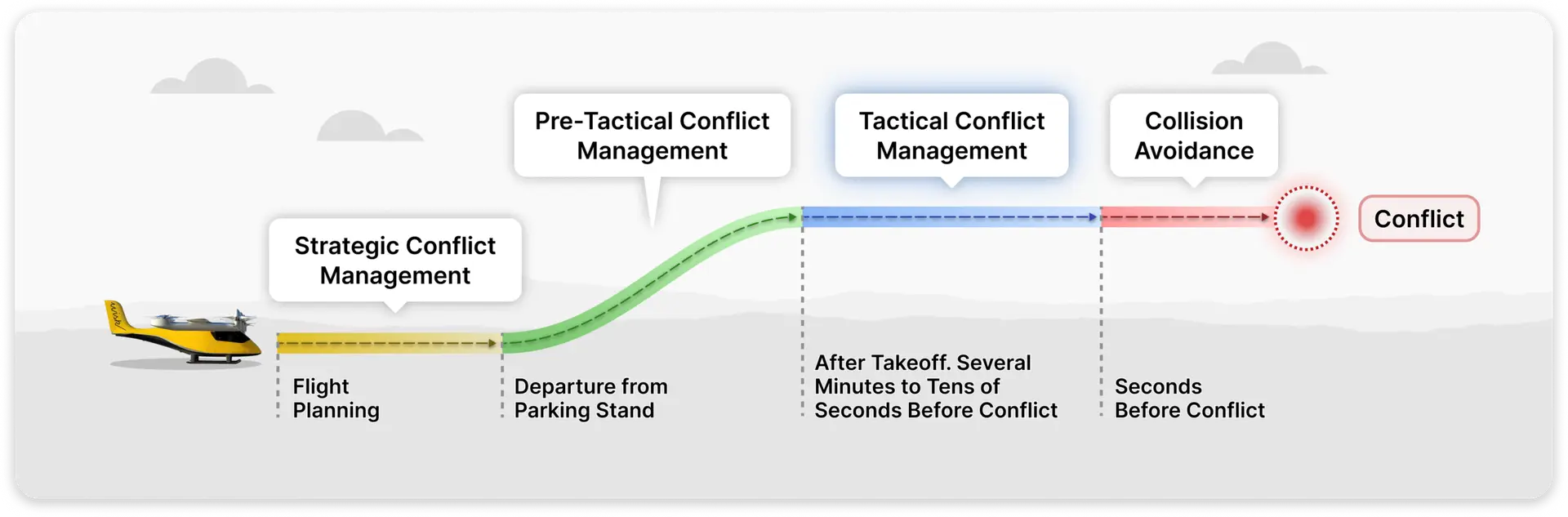
Conflict Management framework proposed for UAM operations in Class X airspace
Conflict Management is automated in distinct phases. Strategic conflict management organizes traffic on the ground before takeoff. Pre-tactical conflict management ensures aircraft are properly spaced at the time of takeoff. Once in the air, tactical conflict management keeps traffic flowing smoothly and aircraft safely separated in the sky.
Tactical Conflict Management: Organizing Traffic After Takeoff
Tactical conflict management is the process of maintaining an orderly traffic flow and ensuring minimum separation between aircraft in flight. It is achieved through in-flight changes to aircraft trajectory and speed, with actions taken tens of seconds to several minutes before a potential conflict.
The ATMS issues maneuver instructions during flight to keep traffic organized and maintain safe separation. This phase of conflict management automation addresses two needs: flow management keeping overall traffic organized while separation provision enforces minimum distance between aircraft.
Leveraging Flow Management and Separation Provision Through SkyGrid’s System
The ATMS keeps traffic organized through two flow management tools: interval management and dynamic rerouting.
Interval management adjusts aircraft spacing and arrival times through cruise speed changes. This handles minor uncertainties or disturbances in traffic flow. UAM aircraft specify a range of in-flight speeds they can maintain as part of their approved flight intent, giving the ATMS flexibility to issue speed changes based on individual aircraft performance.
Dynamic rerouting handles larger adjustments that require changing an aircraft’s trajectory, for example a missed approach that requires re-sequencing an aircraft into the arrival flow or a diversion to an alternate destination within Class X airspace. The ATMS identifies available slots in the current arrival sequence and issues instructions for the aircraft to rejoin the approach. Class X airspace is designed with enough volume to accommodate these maneuvers.
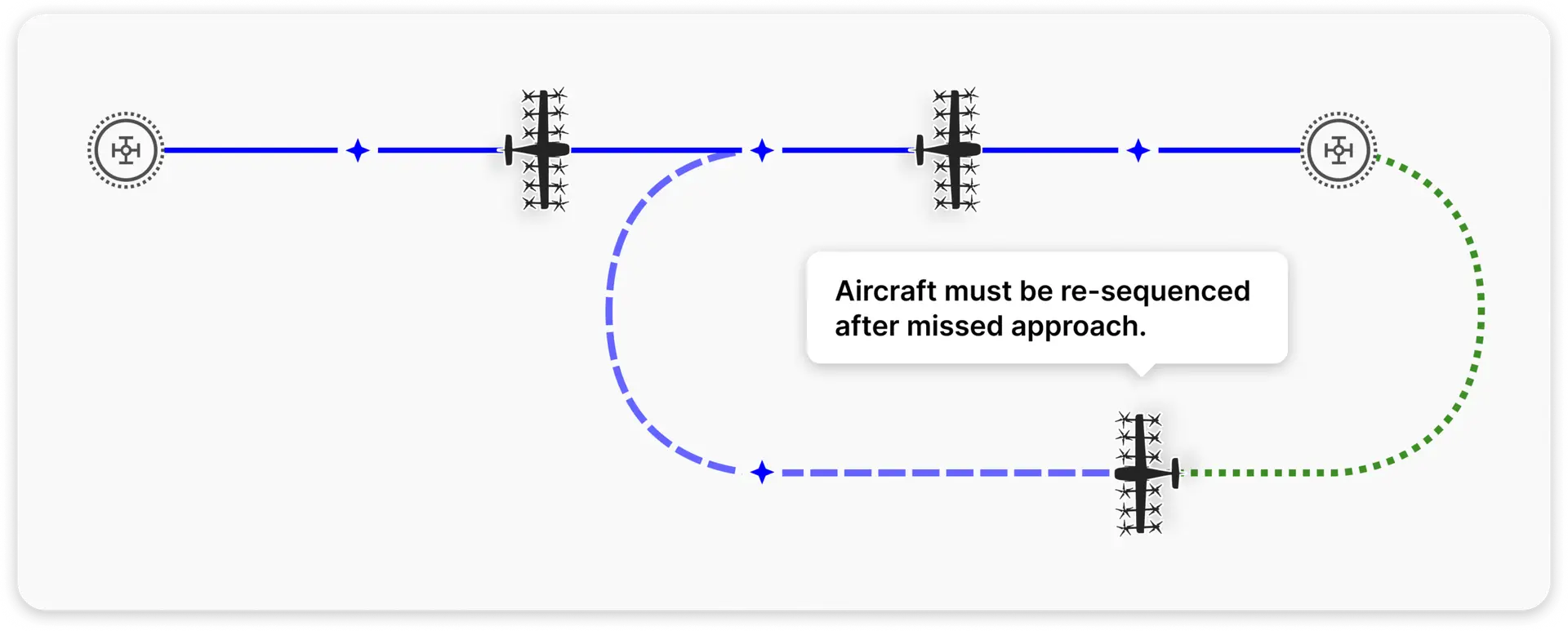
Notional illustration of an example scenario in which dynamic rerouting instructions are provided by the ATMS
The ATMS will also maintain minimum separation distance between aircraft through its separation provision function. Two types of in-flight conflicts are handled by the separation provision function: conflicts involving non-conforming AFR aircraft that deviate from their assigned route or schedule and conflicts involving “intruder” aircraft that unexpectedly enter Class X airspace.
Handling Non-Conforming Aircraft
The ATMS continuously monitors all airborne AFR traffic against lateral, vertical, and along-track conformance thresholds. Each UAM route has pre-specified thresholds and any deviation exceeding these limits gets flagged as a non-conformance condition. For example, an aircraft deviating laterally by more than 0.1 nautical mile on an RNP 0.1 route would be considered non-conforming.
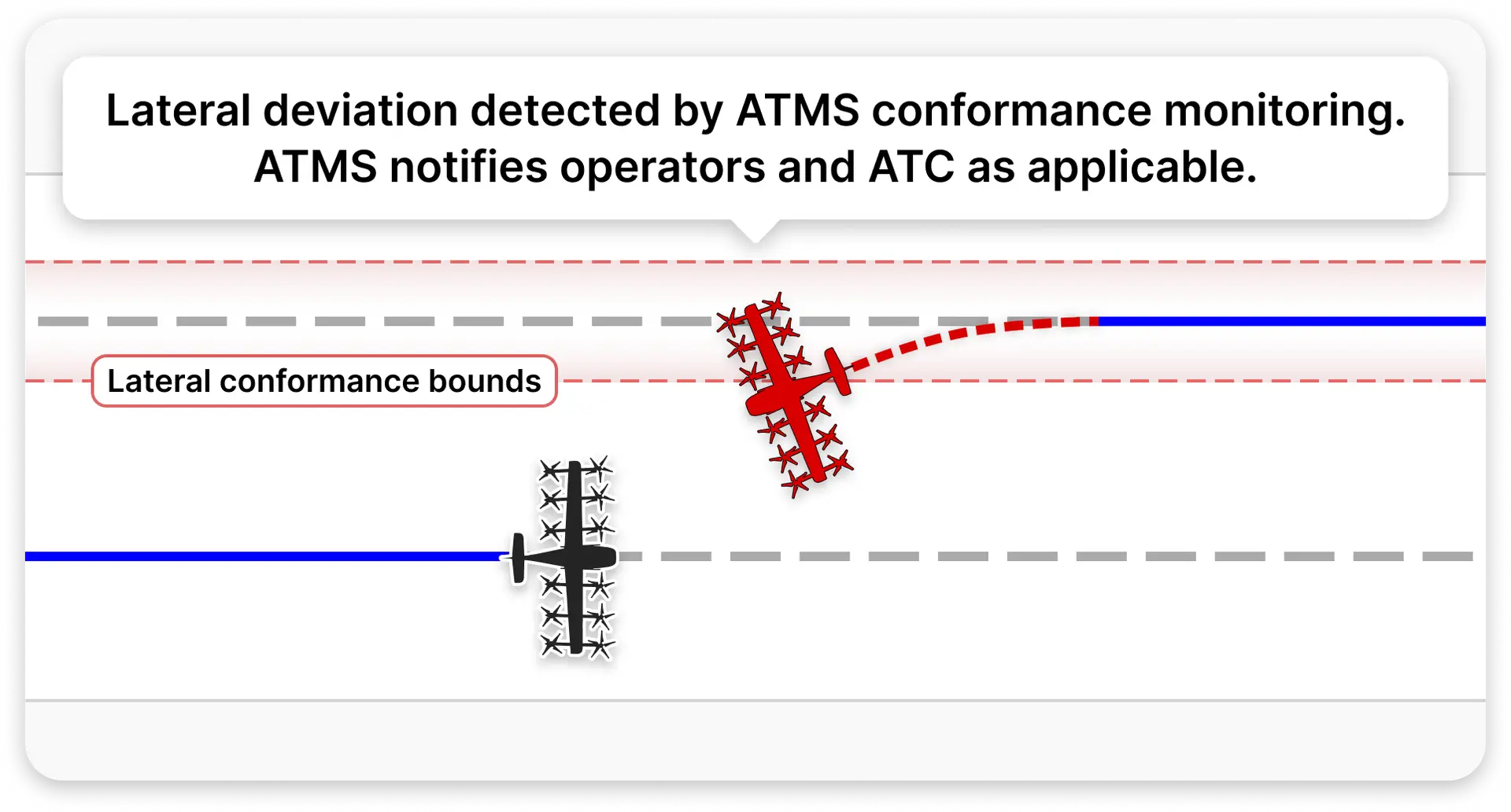
Notional illustration of non-conformance condition due to a lateral course deviation
When the ATMS detects a non-conformance condition, it takes two actions:
- Alerts the non-conforming aircraft, alerts ATC if applicable, and provides instructions to correct the flight trajectory
- Alerts any endangered aircraft and issues maneuver instructions to resolve the conflict if necessary
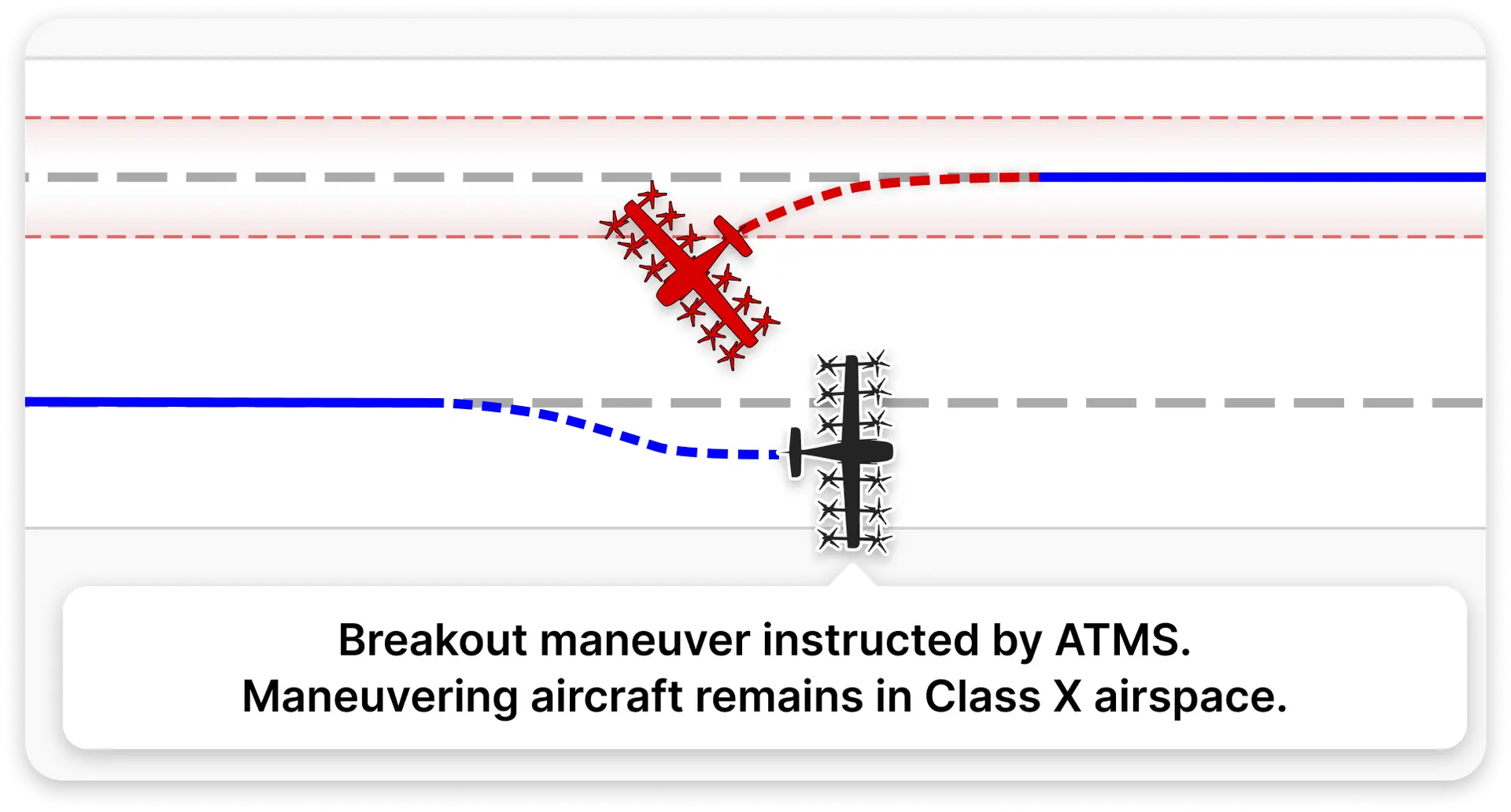
Notional illustration of a deconflicting maneuver instruction issued by the ATMS
This resembles breakout maneuvers used in current IFR approaches to closely spaced parallel runways. Automation enables faster detection of non-conforming aircraft and quicker responses, which allows for closer separation between UAM routes. After resolving the non-conformance condition and associated conflicts, dynamic rerouting and interval management handle any remaining traffic flow disruptions.
Handling Intruder Aircraft
AFR aircraft may encounter non-cooperative traffic that unexpectedly enters Class X airspace. The ATMS provides traffic alerts and maneuver instructions to at-risk AFR aircraft when this happens.
The exact intent of intruding aircraft cannot be assumed, so these instructions follow logic similar to detect-and-avoid (DAA) systems, which operate without traffic intent information. But this goes beyond existing DAA capabilities by addressing additional objectives:
- Maneuvers stay within Class X airspace boundaries when possible
- Maneuvers avoid forcing other UAM aircraft to change their trajectories when possible
- Maneuvers minimize disruptions to overall traffic flow within Class X airspace
- Maneuvers conclude with the aircraft rejoining its planned route
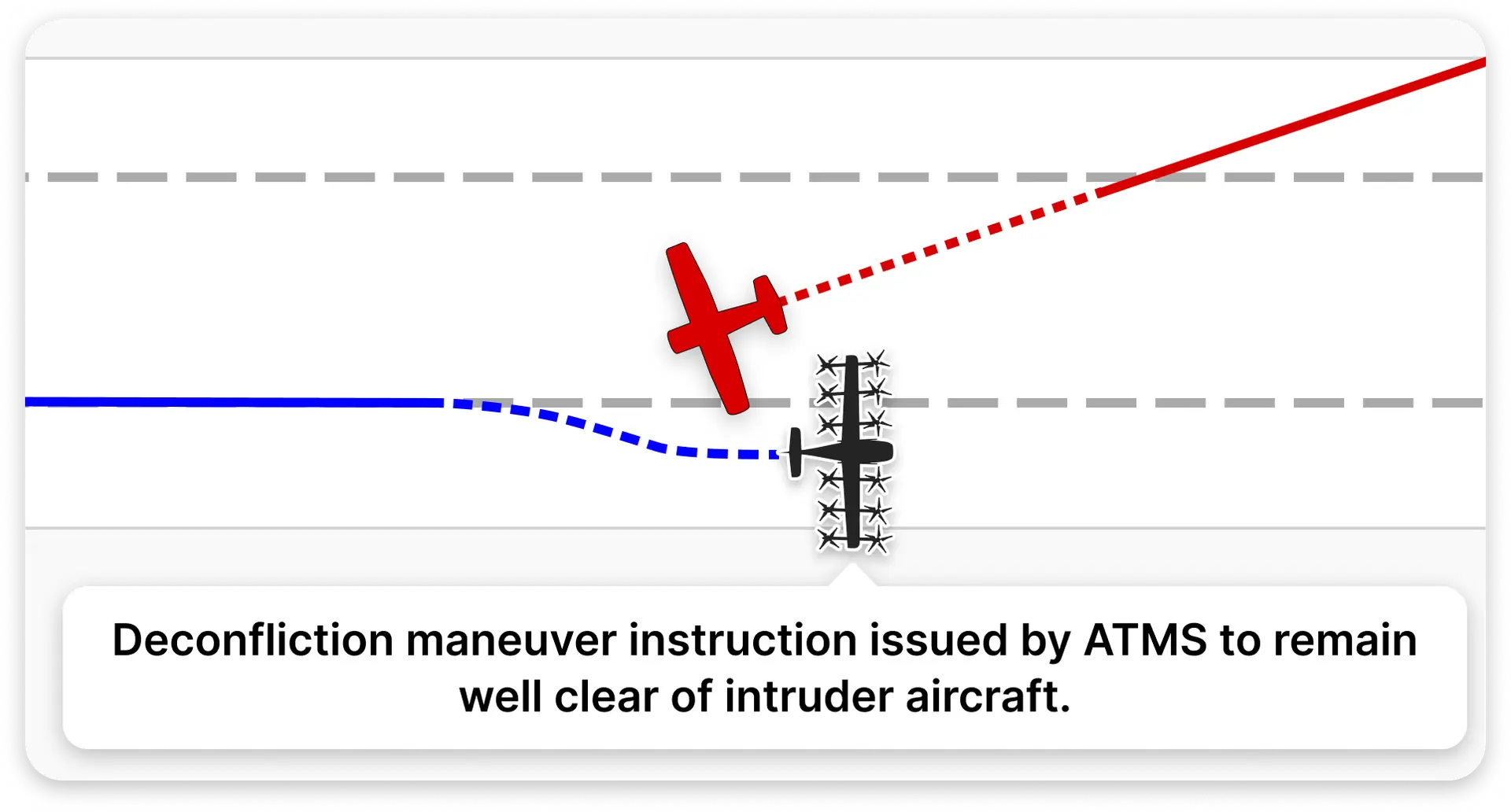
Notional illustration of deconfliction maneuvers issued by ATMS to clear a conflict with an intruder aircraft
Why Tactical Conflict Management Matters
Flight conditions change, wind shifts, aircraft performance varies, and unexpected traffic can appear. Tactical conflict management handles these real-world variations without requiring ATC coordination for every adjustment. The ATMS responds quickly through small speed adjustments or larger trajectory changes as needed.
The system adapts to changing conditions while keeping UAM aircraft safely separated and traffic flowing efficiently. By handling both routine flow management and exception cases like non-conforming aircraft or intruders, tactical conflict management completes the framework that enables high-density UAM operations in Class X airspace.
Learn more about an ATMS can coordinate high-density UAM operations in our new AFR white paper.