
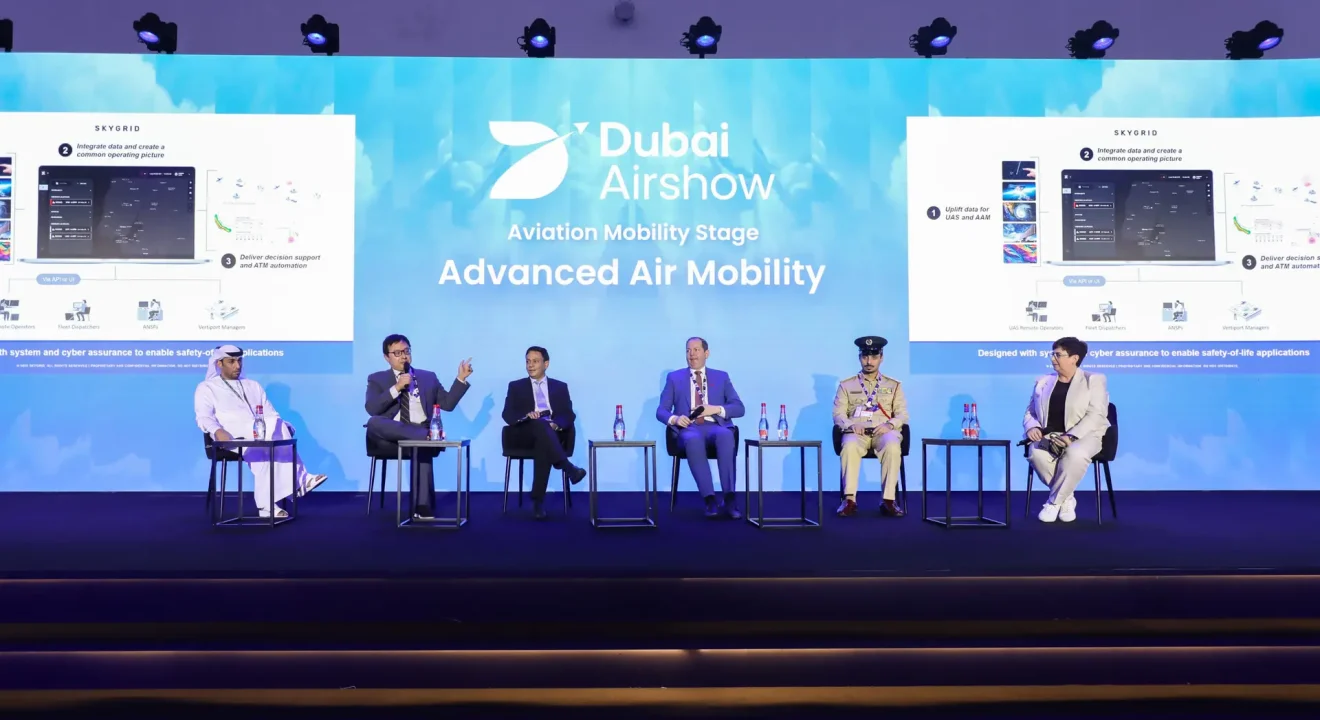
At the 2025 Dubai Airshow, SkyGrid CEO Jia Xu sat down with Jason Pritchard, the Executive Editor of eVTOL Insights. They discussed SkyGrid’s pioneering efforts in the Advanced Air Mobility (AAM) field and the future of autonomous flight, digital aviation, and the journey toward an integrated airspace.
Building the Future of Autonomous Flight
SkyGrid is focused on building highly assured systems and airspace integration technologies for AAM and increasingly autonomous flight. As a Boeing company part of Wisk, SkyGrid works very closely through vertical integration while simultaneously enabling the wider industry.
Our mission focuses on developing high-assurance systems, including digital infrastructure, air traffic management systems, and support systems needed for an integrated airspace where cybersecurity, safety, and design assurance meet the demands of the digital age. We aim to enable more automated access to the airspace by deploying new systems not only to AAM aircraft but also to existing operators and Air Navigation Service Providers (ANSPs).
From passenger-carrying aircraft like eVTOLs to autonomous cargo aircraft, risks need to be managed both in the air and on the ground. SkyGrid’s early system focuses on high-integrity data and surveillance, enabling uncrewed aircraft to understand their environment and operate safely. In the longer term, we’re working on a system to enable greater airspace modernization and automation.
In addition to our product development, we will continue work on the concept development side. In 2024, we published our Concept of Operations for Third Party Services Supporting the Airspace Integration of Advanced Air Mobility, and recently released a joint Concept of Operations for Automated Flight Rules with Boeing and Wisk.
A Collaborative Approach to Autonomy
SkyGrid’s work with Wisk is part of Boeing’s integrated strategy for autonomy—an ambitious and highly collaborative effort. The teams are actively building integrated systems and defining interfaces for digital services, working to standardize these elements from now to ensure seamless future operations.
Through collaboration with the FAA Tech Center, SkyGrid and Wisk are prototyping next-generation PSU services and advanced airspace functions, moving toward operational validation and helping deploy autonomy now. Beyond work with Wisk, SkyGrid is actively collaborating with MIT Lincoln Laboratory to examine how weather affects operational efficiency and to identify new weather technologies that can be sourced today.
Reimagining Low-Altitude Operations
One of the biggest challenges facing urban air mobility today is airspace management at low-altitudes. SkyGrid is currently working with the FAA on cooperative separation, as outlined in the Urban Air Mobility Concept of Operations v2.0. Currently, Air Traffic Control (ATC) can only manage separation for a few aircraft at low altitudes, a major constraint in urban and Instrument Flight Rules (IFR) environments.
SkyGrid is working with the industry to develop cooperative management systems that will automate separation and other management functions at low altitudes for new AAM aircraft. Our new white paper with Eve Air Mobility, Enabling Advanced Air Mobility – Automated Traffic Management Services for Low-Altitude Operations, provides a roadmap for airspace integration and automation while addressing operational and regulatory challenges of integrating these new aircraft into urban airspace.
AAM in the Middle East
The Middle East has demonstrated strong national policies to advance AAM. These countries have a combination of infrastructure and existing airspace that creates a favorable environment for AAM development.
SkyGrid has been actively forming partnerships in the region, including signing Memoranda of Understanding with High Lander to boost AAM ecosystems in the UAE and with King Abdullah University of Science and Technology to advance AAM in Saudi Arabia. We are also supporting Boeing’s initiatives with the General Authority of Civil Aviation and Cluster2 in Saudi Arabia.
AAM requires alignment across three critical dimensions: regulatory frameworks, industrial capabilities, and policy support. The Middle East’s tech-forward policies, combined with a robust ecosystem of technology providers, investment capabilities, and infrastructure, create opportunities for early operations, making it a particularly exciting area for SkyGrid.
SkyGrid’s Vision for Success
In the coming years, successful AAM development looks like the following:
- Fleet Operations at Scale: Enabling one market to achieve scaled operations for new aircraft, demonstrating that the technology and systems can support commercial viability.
- Measurable Progress on Flight Rules: Working as a community to make concrete advancements in automated and digital flight regulations that support this new area of aviation
- Formal Service Approval: Achieving formal approval of SkyGrid’s services that provide safety-of-life functions by an ANSP or Civil Aviation Authority.
By focusing on high-assurance systems, strategic partnerships, and practical pathways to autonomy, SkyGrid is positioning itself as a critical enabler of future AAM operations. With operations beginning in tech-forward markets and continued collaboration with industry partners, SkyGrid is working to ensure that when autonomous aircraft are ready to fly, the digital infrastructure will be ready to support them.
Watch Jia’s full interview here.