
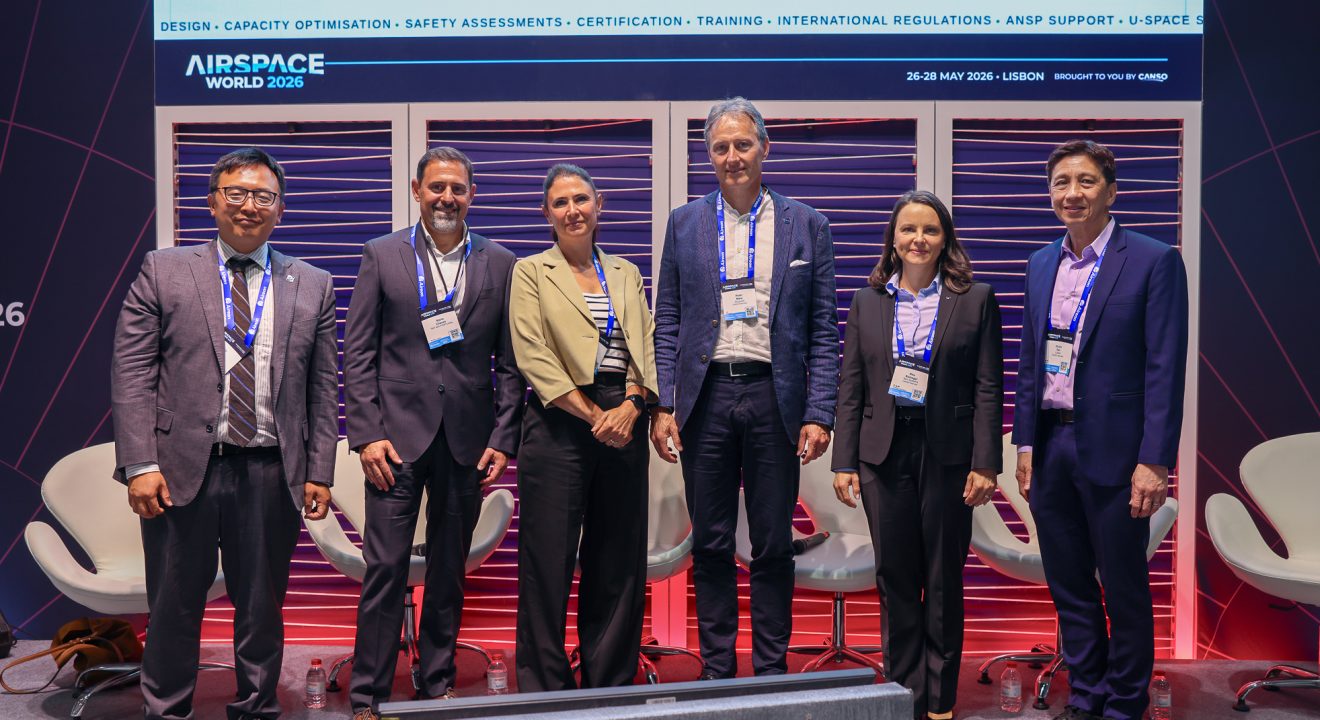
Last month, CANSO Airspace World in Lisbon brought together civil aviation, defense, and Advanced Air Mobility (AAM) experts to discuss how airspace integration can be optimized as different kinds of operations increasingly share the same airspace. SkyGrid CEO Jia Xu joined other industry leaders on a panel exploring how better collaboration and innovative thinking can improve how people, systems, and organizations work together, as well as the policies and governance needed to keep that airspace safe, secure, and resilient.
The conversation centered on a shift already underway in air traffic management: moving from reacting to problems toward proactively planning ahead, so that controllers and pilots can focus less on routine tasks and more on the unusual or unexpected.
Innovating Responsibly
By 2035, drones, air taxis, and autonomous cargo flights are projected to operate at higher tempos than we’ve seen before, and they will enter the airspace whether the infrastructure is ready or not.
In aviation, there is no shortcut to safety. The industry’s safety record is the result of decades of discipline, built by those who held the line through every wave of change before this one. That history sets the terms for what comes next; we must build an airspace that supports new vehicles, new operations, and new levels of autonomy while maintaining the highest safety standards.
New surveillance, weather, and digital communications need to come together so autonomous aircraft are not flying blind. Smarter strategic and tactical deconfliction needs to make the airspace safer and more efficient, and flight rules need to be written to actually take advantage of what safe automation can do.
Creating an Integrated Airspace Together
Integrating new entrants into the airspace is already underway among Air Navigation Service Providers (ANSPs), operators, and civil aviation authorities (CAAs) around the world, and most approaches follow a key principle: build on existing air traffic management (ATM) systems, not around them or instead of them. That requires more than just new technology. ANSPs, operators, and regulators must trust the same data and work from the same picture of the airspace.
Through SkyGrid’s work with the FAA-sponsored Center for Advanced Aviation Technologies (CAAT), we’re developing automated, cooperative separation tools for high-volume AAM—the kind of density that no human controller could safely manage procedurally. At the FAA Tech Center, work with controllers is underway to streamline digital authorization and bring end-to-end strategic deconfliction into AAM operations. Through the FAA’s eVTOL Integration Pilot Program (eIPP), near-term airspace integration is already supporting real, revenue-generating AAM operations.
The architectures behind this work are service-oriented, modular, cloud-centric, and open to a diverse supplier base. None of this is built for AAM alone. It is a bridge between the ATM systems in use today and the digitized, automated airspace coming.
The Risk of Parallel Systems
A real risk in this transition is building two airspace systems that never fully connect: one rooted in traditional ATM, and a separate, segregated system built specifically for new entrants. That future would be dangerous, inefficient, and far less resilient than a single, integrated system built to absorb changes in a high-density airspace.
Separating new entrants from the rest of the airspace is a legitimate and necessary first step in some early-stage operations. It gives new technology room to develop safely while the industry builds out the integration tools and standards it will eventually need. But this separation is a stepping stone, and risks can arise when it becomes the default.
SkyGrid brings the digitization and automation that AAM operations require directly into the systems, workflows, and decision-making of integrated airspace, working within the existing ATM framework rather than around it. The same principle applies to the rules governing how aircraft operate in that airspace. Automated Flight Rules (AFR) will follow the same logic. AFR is complementary to Visual Flight Rules (VFR) and Instrument Flight Rules (IFR), but it is intentionally conceived to natively support autonomous aviation and deeper airspace automation.
Building on a Common Purpose
Building a more digital, automated airspace starts with the same fundamentals: better surveillance and data sharing, smarter deconfliction, and flight rules built for automation. Much of this architectural groundwork is already being developed and refined in AAM.
Leveraging key industry collaborations will help turn that groundwork into a safe, resilient airspace at scale. SkyGrid is extending this work globally, partnering with organizations like Boeing, Wisk, FAA, Port San Antonio, GACA, and KAUST to safely operationalize the future of flight. The opportunity now is to carry this groundwork forward, built on common purpose among industry leaders, operators, ANSPs, and regulators, and on the kind of collaborative culture that keeps an integrated airspace both safe and resilient as it grows.