
Urban Air Mobility (UAM) promises efficient, on-demand transportation that bypasses congested ground infrastructure. But there’s a fundamental problem: the existing airspace system may not scale well to meet UAM’s operational demands.
SkyGrid and Wisk’s new white paper, Enabling Scalable Urban Air Mobility Through Automated Flight Rules, focuses on how Automated Flight Rules (AFR) can support the airspace integration of low-altitude UAM and their safe and efficient scaling beyond the constraints of the current airspace system and outlines how novel automation can enable safe, high-density UAM operations.
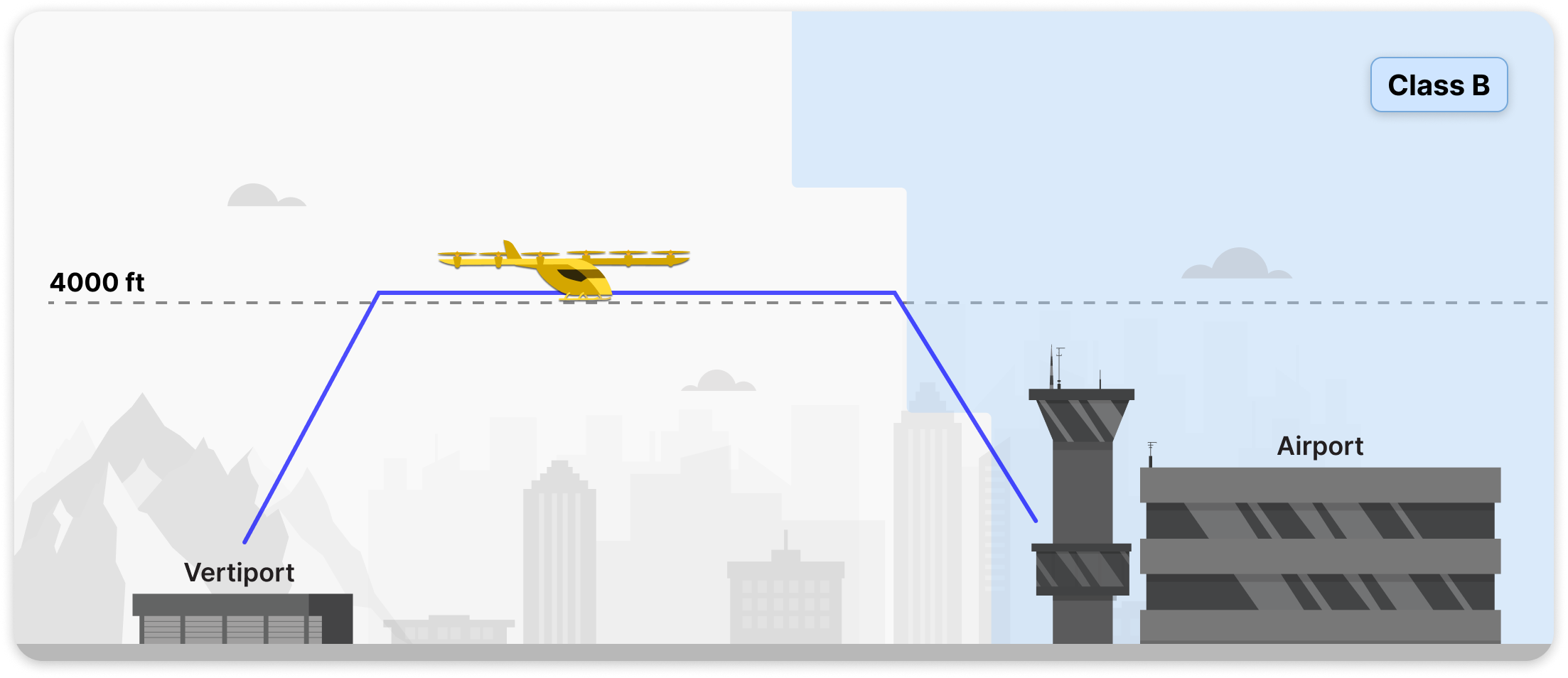
Typical UAM mission profile proposed by the industry
These operations are envisioned to reach high tempos comparable to those observed at major airports and concentrated in low-altitude urban airspace. Today, Air Traffic Control (ATC) relies on human-to-human coordination through voice communications. While this model works right now to keep aircraft safely separated and efficiently organized, it presents scalability limitations; ATC may not have the capacity to manage high-density UAM traffic in already busy airspaces.
Leveraging Automated Conflict Management
Scaling UAM beyond these constraints requires three things: new conflict management automation, new airspace structures where automation safely separates aircraft (referred to as Class X airspace), and new flight rules like AFR that define how aircraft use this automation.
Instrument Flight Rules (IFR) emerged when the industry needed to operate safely in lower visibility conditions, and AFR must emerge to address the needs of increasingly automated aircraft. In Class X airspace, UAM aircraft operating under AFR will be separated by a novel Automated Traffic Management System (ATMS) using all-digital communications, therefore enabling structured, high-density operations without increasing the workload of air traffic controllers managing the surrounding airspace.
Automated conflict management replaces continuous, tactical human coordination with a layered, automation-driven system that organizes traffic in a systematic and predictable manner. Instead of responding to conflicts as they happen, AFR-enabled operations utilize automation to predict, prevent, and handle conflicts at various stages of flight. This change is crucial for supporting high-density UAM operations without overwhelming controllers or needing constant in-flight intervention. The automation of conflict management is a key enabler of AFR. In UAM operations conducted in Class X airspace, conflict management will be automated across different layers.
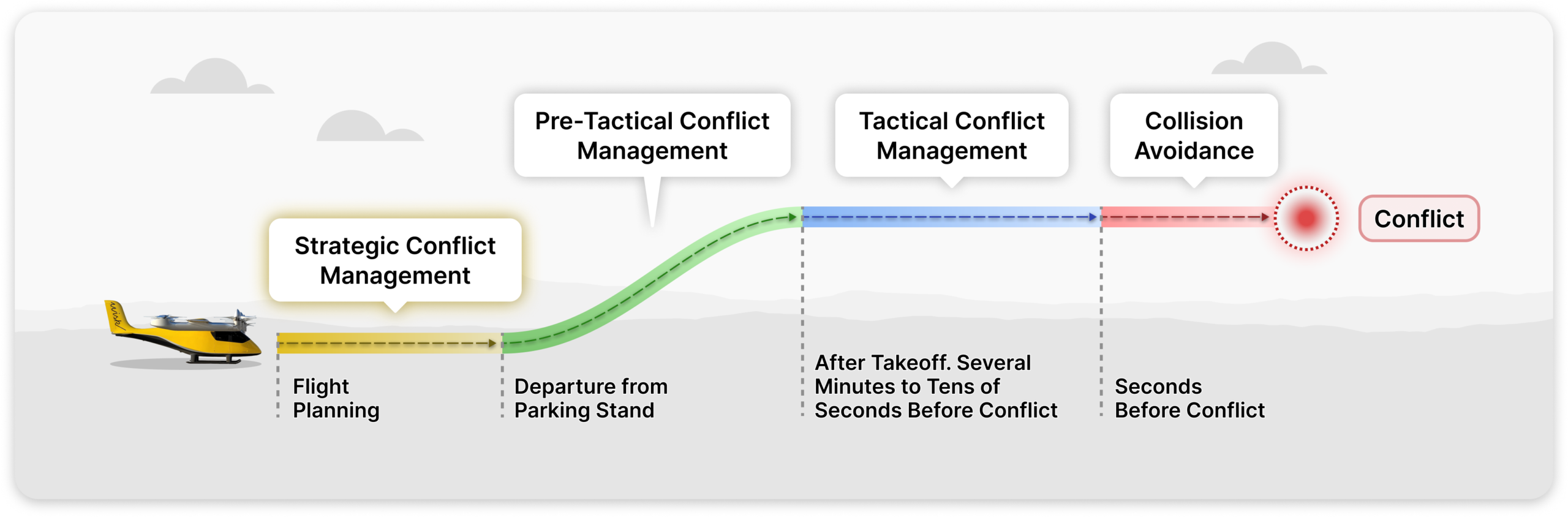
Conflict Management framework proposed for UAM operations in Class X airspace
Strategic Conflict Management: Organizing Traffic Before Takeoff
The foundation of automated conflict management under AFR begins well before an aircraft ever leaves the ground. Strategic conflict management is the process of conditioning the overall traffic flow to make in-flight separation manageable. It is implemented through airspace design and demand-capacity balancing. Actions are taken while the aircraft is on the ground and before it departs. Strategic conflict management aims to reduce, not eliminate, the possibility of in-flight conflicts.
For UAM operations in Class X airspace, the ATMS coordinates everything. As flights are planned, the ATMS balances resource utilization, reserves takeoff and landing slots, and verifies planned flights follow operational rules.
Balancing Demand and Validating Operations Through SkyGrid’s System
Strategic conflict management relies on two key processes automated by the ATMS: demand-capacity balancing and operational intent validation.
Demand-capacity balancing ensures flights are efficiently scheduled. During flight planning, the ATMS evaluates available capacity of both ground infrastructure, like takeoff and landing facilities at vertiports and airports, and airspace resources, including Class X airspace and specific routes and waypoints.
Capacity constraints are communicated to the ATMS by facility operators and ATC or established through operational agreements. The ATMS can then allocate resources to upcoming flights based on this information, scheduling precise takeoff and landing slots that use both airspace and infrastructure efficiently.
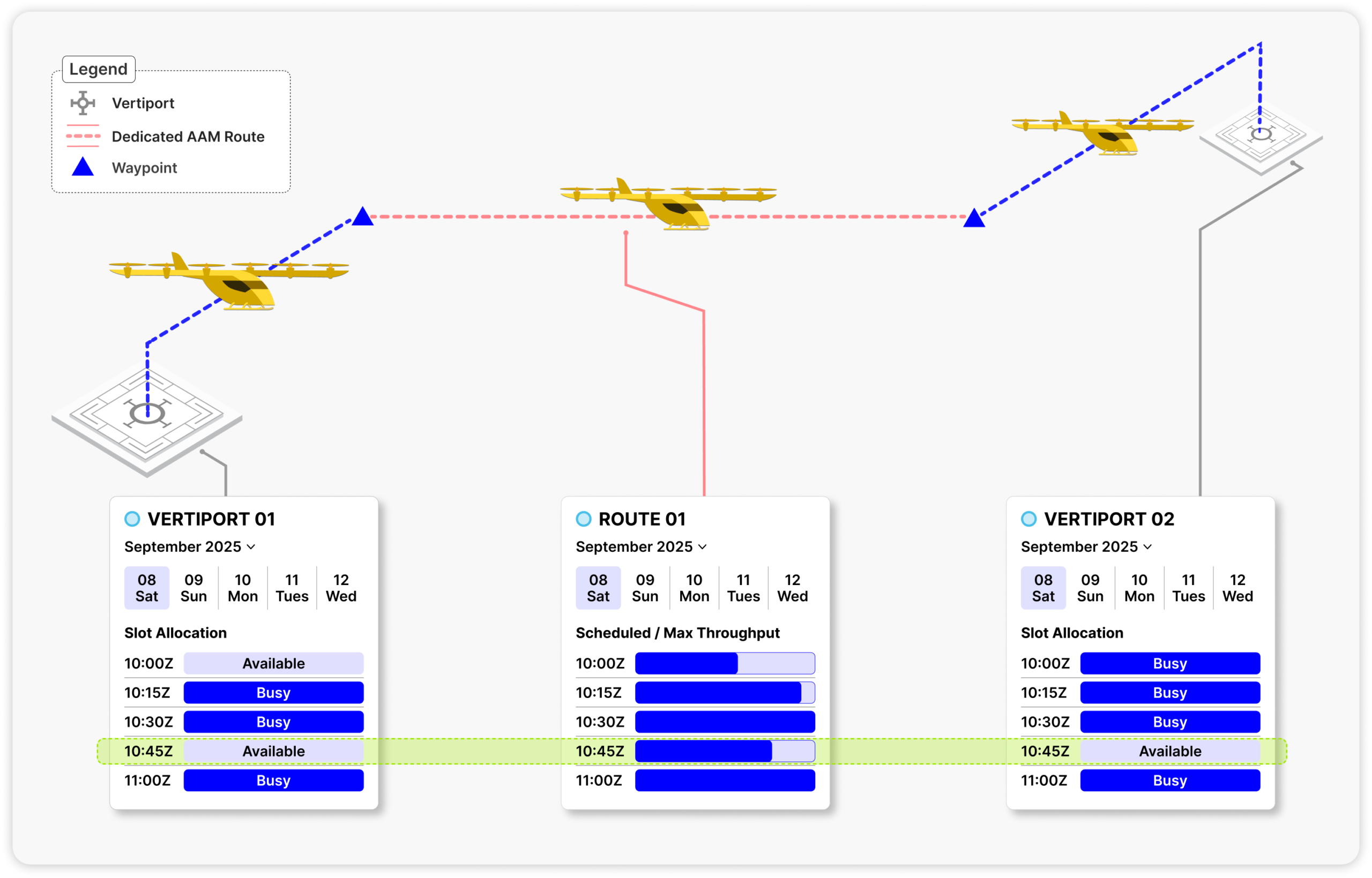
Demand-capacity balancing will be enforced by the ATMS to produce an orderly traffic flow in Class X airspace.
Operational intent validation ensures proposed operations conform to the rules of the airspace. Before departure, the ATMS validates that planned UAM flights adhere to designated routes and altitudes under the expected airspace configuration. Additional operational restrictions are also verified at this stage, such as those related to weather or time of day. This validation process serves a role similar to clearance delivery in conventional air traffic management.
By coordinating slot reservations and flight approvals on the ground, operations in Class X airspace can stay predictable and organized. Since urban flights are short, this combination means UAM operations under typical conditions need little to no trajectory adjustment once in the air.
Aircraft following pre-coordinated, deconflicted flight plans makes the entire system more efficient. Subsequent conflict management layers (pre-tactical conflict management, tactical conflict management, collision avoidance) can focus on exceptions rather than routine separation. Controllers managing airspace around Class X maintain their existing responsibilities without UAM coordination overwhelming them, and urban airspace handles significantly higher traffic densities than traditional methods allow.
Why Strategic Conflict Management Matters
Without strategic conflict management, each aircraft needs dynamic separation instructions throughout its flight. This would create a growing coordination problem as traffic density increases. This stage of automated conflict management solves this by organizing traffic flows in advance—balancing demand, allocating resources, and approving operations before departure—allowing decisions to be processed at machine speed and scale, far beyond what human operators alone could manage.
The automation handles the systematic and predictable aspects of air traffic organization. It doesn’t replace human judgment in complex situations. Instead, it creates conditions for safe, efficient, high-density operations, giving us a path to scalable UAM operations beyond today’s airspace constraints.
Strategic conflict management is just the first layer. The complete AFR framework includes processes for separation management during flight, with collision avoidance as a final safety net. But without a well-organized, strategically deconflicted traffic flow as a foundation, those subsequent layers get overwhelmed before they can be effective.
Learn more about automated conflict management and enabling scalable UAM in our new AFR white paper.