
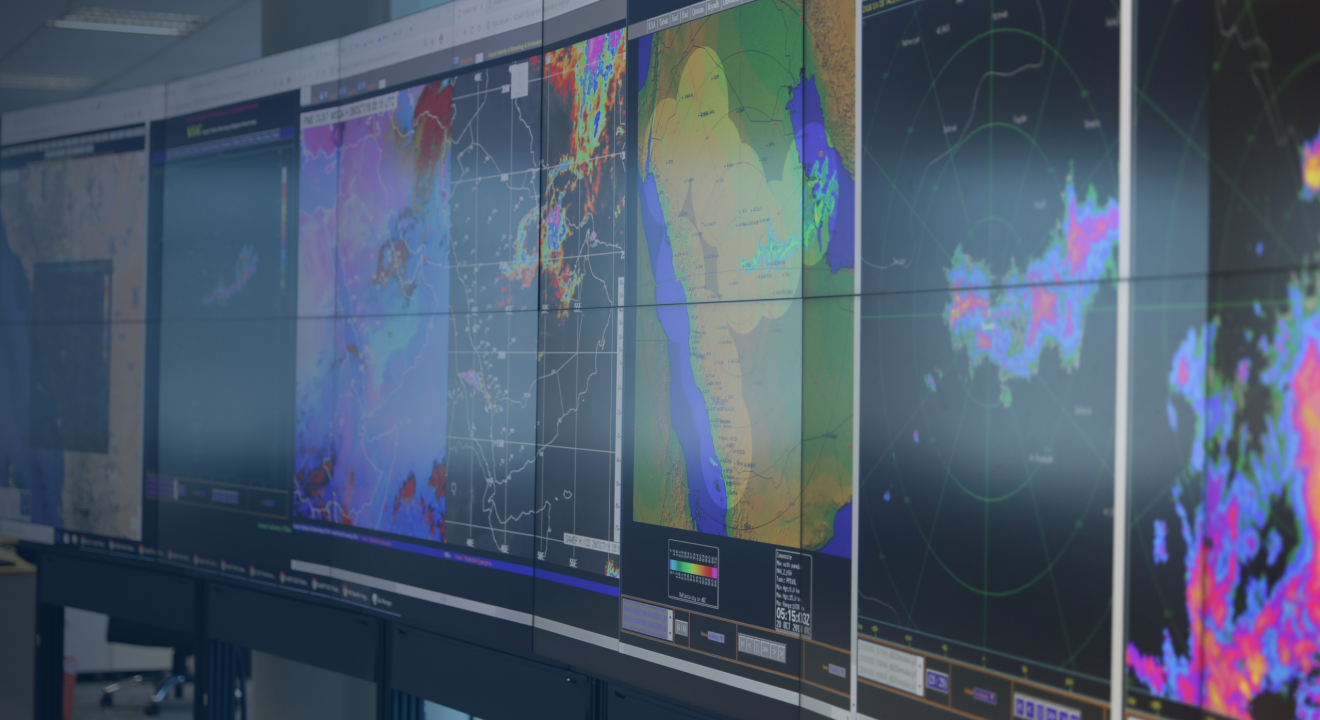
Second phase builds on first-year findings, adding new data sources, expanded hazard products, and probabilistic forecasts to prepare the models for operational use.
AUSTIN, TX, November 12, 2026 – SkyGrid, an Advanced Air Mobility (AAM) Third-Party Service Provider (TSP), today announced it has extended its Cooperative Research and Development Agreement (CRADA) with MIT Lincoln Laboratory to continue developing high-resolution weather forecast systems that enable safe, scalable AAM operations. The new phase runs through July 2027 and represents a shift from evaluation to maturation of high-resolution forecast (HRF) models for future operational use.
The partnership began in October 2025, pairing SkyGrid’s traffic management, airspace integration, and simulation expertise with MIT Lincoln Laboratory’s decades of work in aviation weather sensing, forecasting, and decision support. In its first year, the team evaluated Lincoln Laboratory’s HRF data using SkyGrid’s AAM simulation environment to study how higher-fidelity, higher-resolution forecasts affect operational planning in terms of both safety and efficiency. That work produced an early framework for AAM-specific weather requirements, presented at the AIAA AVIATION 2026 Forum.
AAM operations, from autonomous cargo flights to passenger-carrying eVTOL services, are conducted at low altitudes where weather conditions such as winds, turbulence, visibility, and convection can change rapidly and over short distances. Forecasts built for conventional aviation typically cannot resolve low-altitude conditions, lacking the resolution needed to capture the rapid, small-scale dynamics of weather phenomena near the planetary boundary layer. The second phase of the partnership targets that gap directly by upgrading the models to better capture low-altitude weather, evaluating the forecasts with sensors deployed across a range of operational sites, and enhancing SkyGrid’s simulation environment and decision support tools to more realistically depict AAM operations.
“Year one showed us that forecast resolution isn’t an academic detail; it shapes how confidently you can plan and sequence autonomous flights while maximizing safety and efficiency,” said Jordan Cohen, R&D Lead at SkyGrid. “In this next phase, we’re stress-testing the models against more hazards, in more regions, and with real-world uncertainties, so operators can scale with weather data they can trust.”
In the new phase, the team will:
- Improve Lincoln Laboratory’s HRF forecast accuracy by integrating high-resolution terrain and sensor data, including surface weather stations, aircraft reports, radiosondes, NEXRAD, and LIDAR.
- Evaluate the HRF model against observations from sensor networks deployed at a range of test sites across the United States.
- Identify the sensors and sensor configurations that maximize forecast accuracies at low altitudes.
- Expand HRF hazard products to include turbulence, 3-D visibility, icing, and precipitation.
- Introduce probabilistic forecasting in HRF models through ensemble approaches and 4-D error models, providing planners a measure of forecast confidence rather than a monolithic result.
- Upgrade SkyGrid’s simulation environment with new aerodrome networks, more realistic ground-operations models, and more representative traffic schedules to produce higher-fidelity simulations of AAM operations at different operational tempos and scales.
- Measure the operational value of higher resolution forecasts by comparing the HRF model against NOAA’s current operational forecasting system, the High-Resolution Rapid Refresh (HRRR) model, in simulations of AAM flights across multiple regions and seasons.
“The first phase confirmed that high-resolution forecasts can make a measurable difference for highly automated flight,” said Dr. Gabriele Enea, Assistant Group Leader, Air Traffic Control & Weather Systems Group at MIT Lincoln Laboratory. “Now we’re focused on making these models more accurate, more complete, and better understands their uncertainty, which are the steps needed before they can support real operations.”
By linking gaps between forecast and observed weather to their operational impacts, such as delays, reroutes, or cancellations, the team will propose weather forecast requirements for AAM grounded in both meteorology and operational outcomes. The proposed requirements are intended to inform regulators, service providers, and operators as the industry scales.
About SkyGrid
SkyGrid exists to open the sky for autonomous flight. Based in Austin, Texas, SkyGrid builds high-assurance third-party services to enable the safe operation and integration of autonomous aircraft. SkyGrid also acts as the operational nexus for Advanced Air Mobility, integrating and managing data, infrastructure, access, and traffic to support scaled operations. SkyGrid is part of Wisk Aero, an Advanced Air Mobility Company, headquartered in California. Learn more about SkyGrid here.
About MIT Lincoln Laboratory
MIT Lincoln Laboratory is a Department of War Federally Funded Research and Development Center operated by the Massachusetts Institute of Technology, conducting research and development to address national security challenges. Its Air Traffic Control and Weather Systems Group has developed aviation weather sensing, forecasting, and decision support technologies for more than 50 years. Learn more about MIT Lincoln Laboratory here.