
As a key contributor to Boeing’s VARIANT research initiative, SkyGrid is developing and validating the ground-based digital services that will make autonomous urban flight safe, scalable, and ready for market.
Boeing Aerospace Spain (BAS) today announced the VARIANT project — Validation of AiRspace Integration Applications and New Technologies — a strategic research initiative to enable the safe integration of electric and autonomous aircraft into the current airspace. SkyGrid is a major contributor to the initiative, responsible for advancing four critical ground-based capabilities that sit at the heart of any viable urban air mobility ecosystem.
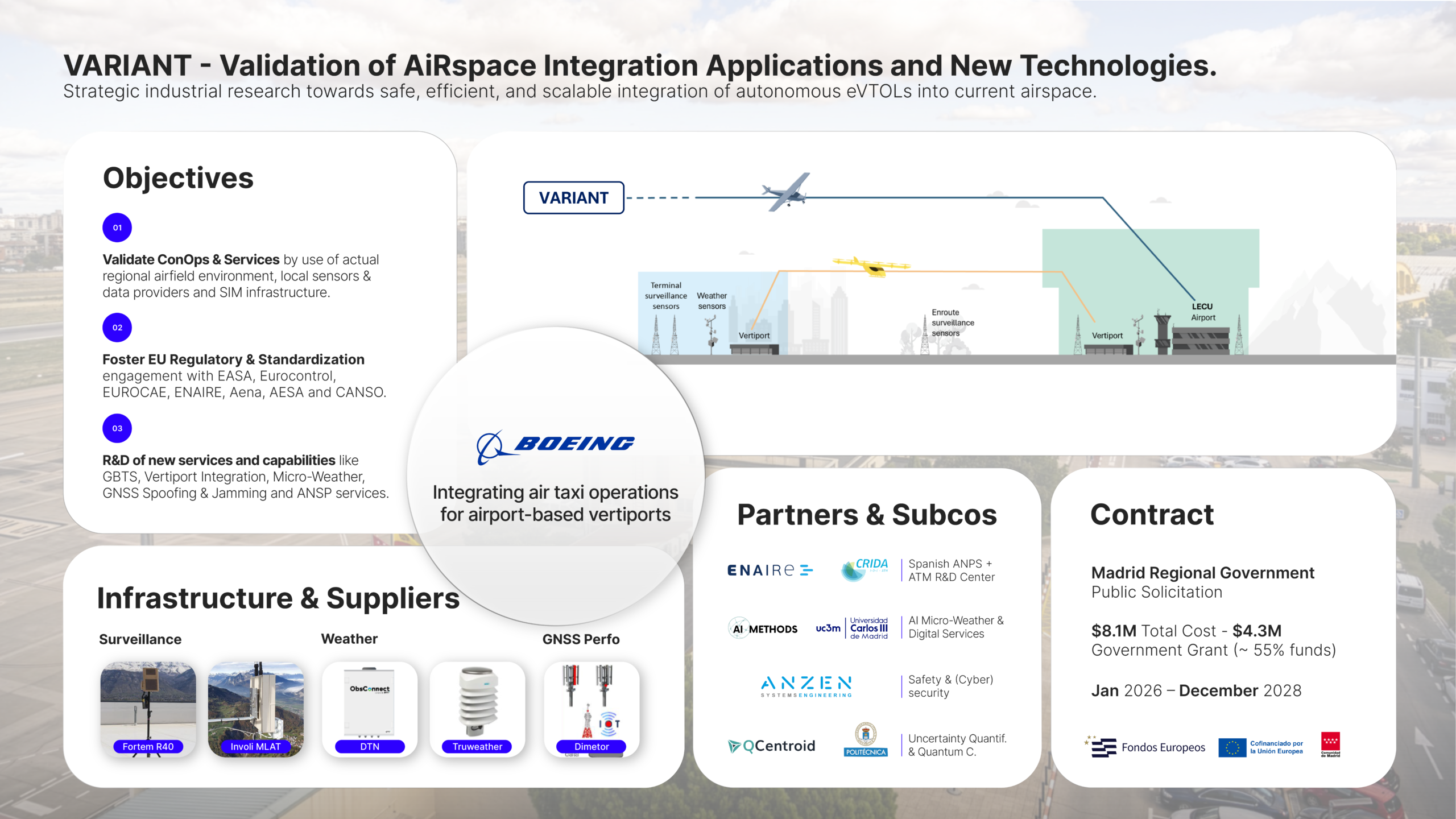
While the full consortium includes ANZEN Engineering, AI Methods, QCentroid Labs, and leading Spanish academic and regulatory institutions, SkyGrid’s mandate within VARIANT is technically distinct: to develop, integrate, and validate the ground-based intelligence layer that autonomous aircraft depend on to operate safely and predictably.
Four capabilities. One objective: making autonomous flight reliable.
- Ground-based traffic surveillance: Deploying radar and ADS-B & FLARM sensor networks for real-time awareness of cooperative and non-cooperative aircraft in low-altitude urban corridors.
- Micro-weather: Integrating high-resolution atmospheric data streams and AI-driven nowcast models tailored for eVTOL flight planning at low altitudes.
- Vertiport resource management: Pioneering digital services for autonomous scheduling and allocation of takeoff and landing slots across eVTOL fleets at scale.
- GNSS spoofing detection: Validating LTE-based monitoring to detect GPS jamming and spoofing threats — a prerequisite for safe autonomous navigation.
These are not theoretical capabilities. VARIANT’s iterative methodology — grounded in NASA Technology Readiness Levels 1 through 4 — ensures that SkyGrid’s contributions progress through structured cycles of design, prototyping, and real-world validation. The project’s simulation environment is centered on Madrid Cuatro Vientos aerodrome, providing a high-fidelity operational testbed that includes human-in-the-loop scenarios with air traffic controllers and operators.
“Safe autonomous aerial operations depend on reliable situational awareness, resilient positioning and timing, and intelligent vertiport management. VARIANT accelerates the development and validation of these ground-based services for high-density, low-altitude environments.” — Jia Xu, CEO, SkyGrid
A defining feature of VARIANT — and one of particular strategic value to SkyGrid — is the project’s collaboration with ENAIRE, Spain’s national Air Navigation Service Provider. ENAIRE will contribute operational expertise, support definition of the operational concept, and provide access to U-space and ATC simulators for integrated validation exercises.
For SkyGrid, this creates a rare opportunity: validating ground-based traffic management solutions in a real ANSP environment, aligning with European regulatory frameworks before formal certification processes begin, and building a long-term relationship with a leading European airspace authority. As SkyGrid looks to expand its footprint in the growing European urban air mobility market — projected to reach $55 billion by 2034 — this kind of early regulatory engagement is a meaningful competitive advantage.
Infrastructure built for the next generation of flight
VARIANT includes the procurement and deployment of cutting-edge sensor infrastructure from Fortem, Involi, DTN, Truweather, and Dimetor — hardware that will directly underpin SkyGrid’s development, integration, and validation work throughout the project lifecycle. This testbed infrastructure accelerates product development cycles and generates proprietary data and intellectual property in digital traffic surveillance, micro-weather, and GNSS security.
The result is a ground-based service stack — validated against real aircraft, real weather, and real airspace — that positions SkyGrid to lead the next phase of urban air traffic management.