
Every day, the FAA manages more than 45,000 flights and 2.9 million passengers across the national airspace. That scale is the result of more than a century of progress in which people and technology advanced together, with each new tool expanding what the airspace could support.
Aviation is at another inflection point. High-density uncrewed aircraft, eVTOLs, and increasingly autonomous operations are arriving in the same airspace that carries today’s commercial traffic. We have to build for what comes next.
Integrating with Today’s Airspace
Air Navigation Service Providers (ANSPs) have safely managed air traffic with voice communications and surveillance tools. These systems remain foundational, but they were not built for the volume and variety of operations Advanced Air Mobility (AAM) will introduce, and replacing them is not financially or operationally realistic. The path forward requires integrating new tools into legacy systems, with controllers staying at the center of air traffic management.
New aircraft, new kinds of operations, and increasing levels of autonomy all have to coexist within the airspace we rely on today. That makes integration the central task: every participant needs to operate as part of one coordinated environment, meaning AAM is an air traffic challenge just as much as an aircraft one.
Automating Routine Work
Automation has always been part of aviation. From early autopilot systems to modern air traffic control, technology has steadily taken on tasks that help people manage greater complexity. Autopilot did not replace pilots; it handled routine tasks so pilots could focus on timely, critical decisions. This capability never made its way into the control tower.
The need is clear in low-altitude airspace. Helicopters are typically managed through visual clearances and voice communication, often by a dedicated tower controller. That works at today’s density, but it does not scale to dozens of cargo flights, eVTOLs, and helicopters operating at once, and staffing to that level is not feasible. Automation can absorb the routine, high-volume work:
- Flight plan validation and demand-capacity balancing: Proposed plans are checked against traffic, weather, and closures, so vertiports and airspace segments are not over-allocated before a request reaches ATC.
- Strategic deconfliction: Conflicting trajectory intents are resolved before departure, so fewer conflicts reach the tactical phase.
- Conformance monitoring: Controllers and operators are alerted when a flight deviates from its plan, so attention goes where it is needed.
With fewer real-time interventions, controllers can concentrate on oversight and complex judgment calls. Automation handles the routine so human expertise stays where it matters most.
Building a Common Operating Picture
Integration means connecting aircraft, data, services, operators, infrastructure, and the decisions made across the ecosystem. The technology has to turn this complex system into something usable, giving people and automated systems a common operating picture.
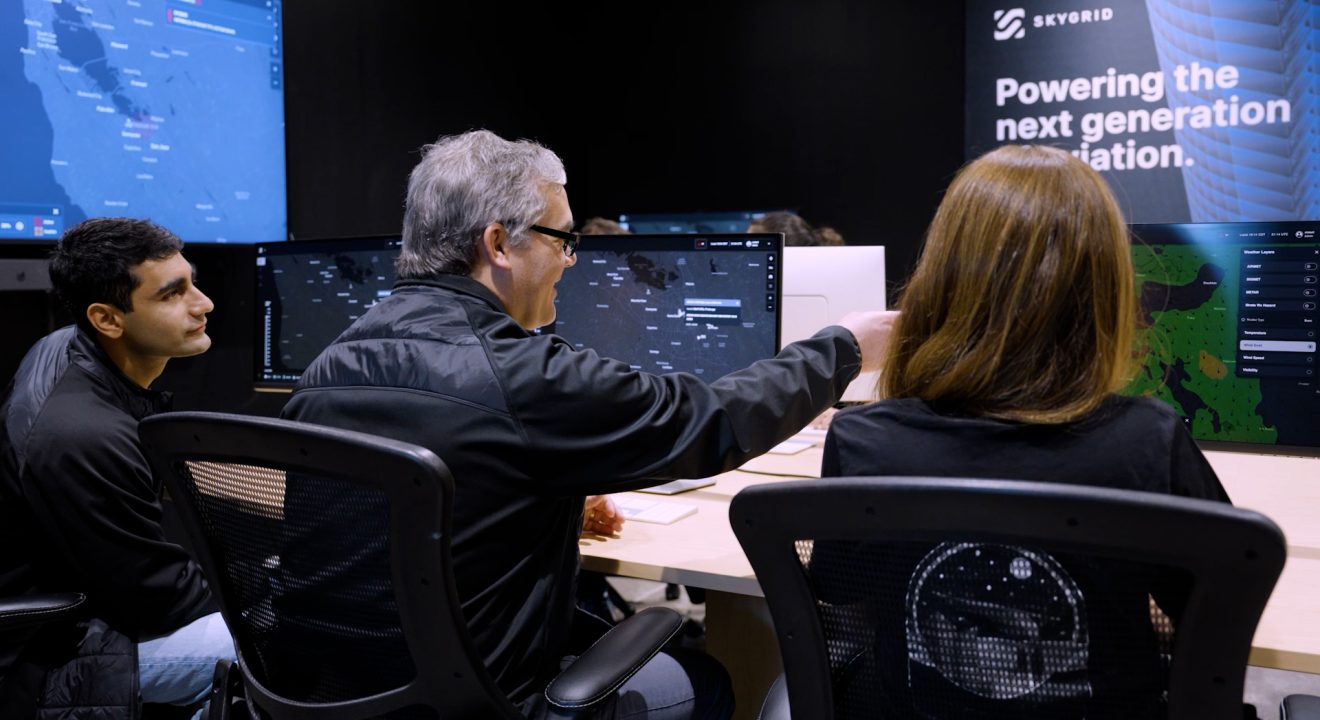
SkyGrid does this through its ground-based, high-assurance data services and ATM automation platform that sits between operators and ANSPs. It augments existing ANSP tools with services built for low-altitude, uncrewed traffic, forming the data backbone for AAM:
- Ground-Based Traffic Surveillance: High-integrity, low-latency surveillance data for low-altitude airspace
- Weather Data: Reports, forecasts, and observations at vertiports
- C2 and GNSS Performance Data: Alerts when satellite-based services used by AAM operators are expected to be degraded or unavailable
- Resource Status and Capacity Data: Visibility into the status and capacity of takeoff and landing sites
When routine ATC tasks are automated, the data behind them has to meet the highest standards for accuracy, integrity, timeliness, availability, and security. That is why these systems are developed and tested to aviation safety standards.
What Comes Next
This evolution will happen in phases. Initially, ANSPs receive the data and decision support to integrate new aircraft into their current airspace structures. Over time, they can take a more strategic role, setting capacity limits and times of operation instead of managing every aircraft individually.
Updated regulations and Automated Flight Rules (AFR) can support this shift by establishing clear responsibilities for third-party services and predictable procedures for uncrewed operations. Validation matters just as much, which is why SkyGrid is working with the FAA and industry partners to test concepts in real-world environments.
We see the future of airspace as the next step in a pattern aviation has followed from the beginning: use technology to expand what people can do. SkyGrid’s role is to help architect an airspace that is ready for what comes next.