
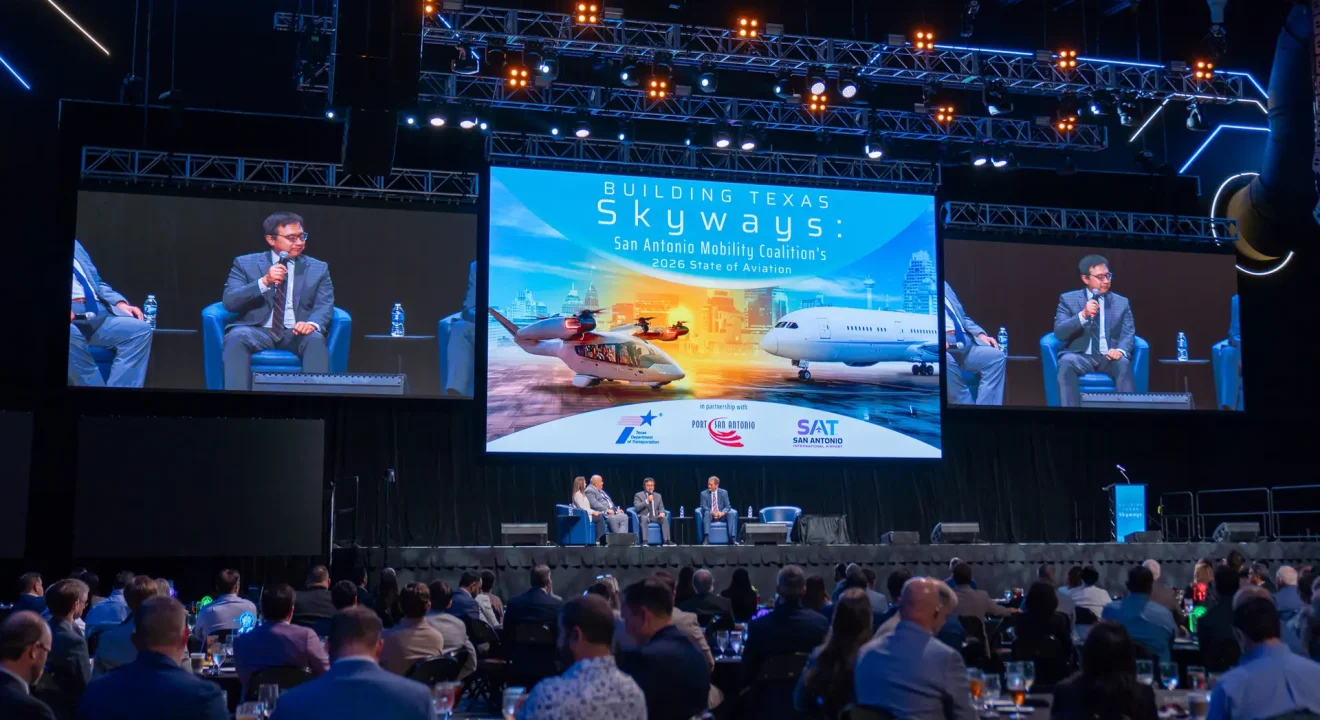
The 2026 State of Aviation in San Antonio brought together civic leaders, operators, and innovators to take stock of where aviation stands today and where it is headed. SkyGrid CEO Jia Xu joined Jim Perschbach, President and CEO of Port San Antonio, and Jesus Saenz, Director of Airports at the City of San Antonio, on a panel covering where aviation stands today, the benefits of smarter airspace management, and what bringing Advanced Air Mobility (AAM) to San Antonio means for the city and its communities.
Doing More with the Airspace We Have
Aviation is entering its next generation, and with it comes a shift in how the industry thinks about growth. The National Airspace System (NAS) faces challenges including air traffic controller shortages, aging systems, and congested airspace. The instinct is to build more runways, hire more staff, and fix more infrastructure. But this approach has limits, both financially and practically.
Better airspace management, through the application of AI and intelligent cybersecurity, offers a different path. Aircraft would function as an extension of the municipal transportation system rather than a separate one, with hub takeoff and landing sites built where land is accessible and affordable, integrated with the kinds of services communities actually need.
Smarter airspace deconfliction can delay the need for new infrastructure while getting more value out of what already exists. That is the space SkyGrid is focused on: managing and understanding the low-altitude airspace to make better use of the significant investment going into this work.
Expanding Access Where It Matters
The benefits of opening low-altitude airspace extend well beyond aviation operators. In Texas, rural, urban, and suburban areas sit in close proximity, yet direct access to food, healthcare, childcare, and employment is unevenly distributed. Physical infrastructure like bridges can cost millions of dollars and still may not serve pedestrians. Better use of the airspace changes that, giving people in underserved communities a faster, more affordable path to the jobs and services that drive economic participation.
Leveraging Automation Across the Broader Aviation Ecosystem
Much of the separation currently required between aircraft exists because closing speeds exceed human reaction time. Safely reducing that separation requires automation. Solutions that allow aircraft to operate in closer proximity to each other and to airports can cut unnecessary separation, reduce delays, and limit the need to route flights through adverse weather, with humans and automated systems working together throughout.
The safety and efficiency gains from better low-altitude airspace management and surveillance extend to the broader aviation ecosystem as well. The software and hardware being built for AAM will open up new ways to improve low-altitude situational awareness for traditional aviation, giving pilots, planners, and operators access to high-fidelity traffic information they have not had before. That means fewer delays, better utilization of existing infrastructure, and new possibilities like more parallel runway landings that were not practical without this level of airspace awareness.
The surveillance capabilities being developed for autonomous aircraft, including fused sensor solutions designed to detect and avoid hazards, can also provide feeds to the broader aviation ecosystem. More thorough data on what is happening in the airspace benefits everyone flying in it, not just new advanced aircraft. As these tools mature, the case for applying responsible automation as a safety layer across the NAS becomes increasingly clear. The approaches being developed and tested today in cities like San Antonio have the potential to set the standard for how aviation evolves nationally and globally.
San Antonio’s Role in AAM
Legislative leaders are approaching advanced aviation with a sense of urgency. There is broad recognition that this is a national effort that requires sustained policy commitment, alongside technological and regulatory progress. This includes a willingness to learn from how other regions around the world are developing these systems.
The regions that move deliberately today will be the ones that define what aviation looks like in the near future. Texas is well positioned to be a significant player in this next era, and the investment is already flowing in. Programs like the FAA’s eVTOL Integration Pilot Program (eIPP) and Center for Advanced Aviation Technologies (CAAT) are well funded, and the economic impact stays local through jobs and investment. San Antonio in particular has the industry relationships, aviation legacy, and a community open to new approaches. SkyGrid is building toward this future in San Antonio through a partnership with Port San Antonio and by supporting the Texas coalition of the eIPP.