

Modern aviation has operated under two main modes for nearly a century: Visual Flight Rules (VFR) and Instrument Flight Rules (IFR). While these modes have enabled aviation’s safe growth, they weren’t designed to accommodate highly automated aircraft with advanced capabilities like detect-and-avoid systems and advanced mission management automation. Automated Flight Rules (AFR) are designed to fill this need by complementing VFR and IFR, offering advantages to a vast range of airspace users.
What are Automated Flight Rules?
AFR represents a concept for flight operations that leverages automation at its core. Unlike VFR and IFR, which were designed for human-centric operations, AFR is purpose-built for an era of digital communication, advanced automation, and increased connectivity.
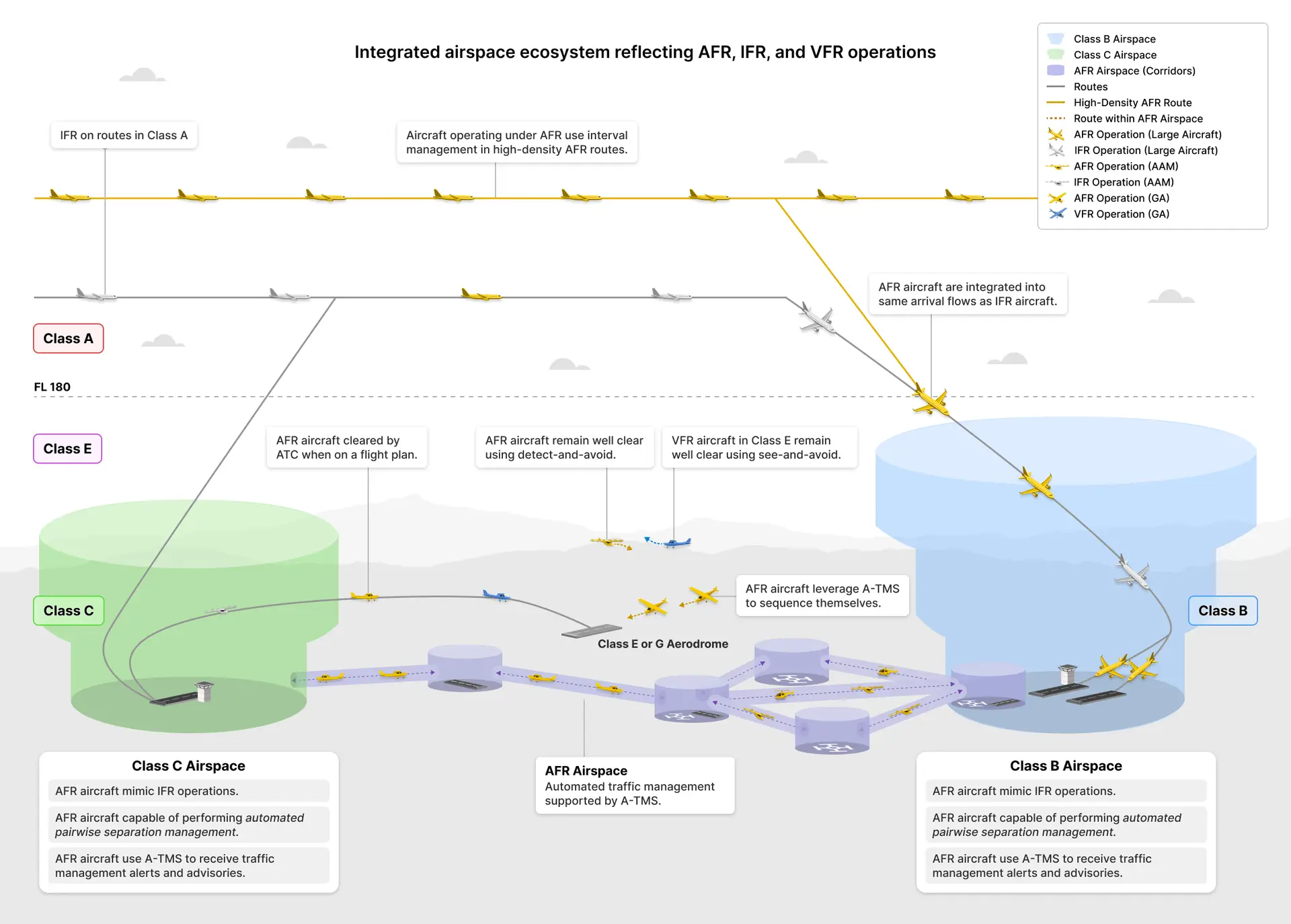
Integrated airspace ecosystem reflecting AFR, IFR, and VFR operations
Boeing, SkyGrid, and Wisk’s Concept of Operations for Automated Flight Rules outlines a vision where AFR complements existing flight rules and supports highly automated aircraft operations. Any aircraft equipped with the right capabilities, from eVTOLs to commercial jets, will be capable of flying under AFR.
Features of AFR
At its core, AFR introduces greater automation into how air traffic is organized and how aircraft remain safely separated in specific airspaces and scenarios. By formalizing the use of automation in new flight rules, several opportunities are presented:
- AFR will allow aircraft to operate safely and routinely without the need to assume that a pilot is present in the cockpit (and without the need for waivers and exceptions). Today’s flight rules (VFR and IFR) carry a fundamental assumption that a pilot will be present in the cockpit to detect other traffic visually and to communicate with Air Traffic Control (ATC).
- AFR will allow operators to fly more efficient trajectories that are not constrained by the types of conflicts that humans can effectively anticipate and resolve. This increases operational efficiency.
- AFR will support the airspace integration of new entrants such as Advanced Air Mobility (AAM) without necessarily increasing the workload of air traffic controllers. This increases airspace capacity and access.
The successful introduction of AFR will require several technical enablers, with a key one being the availability of high-integrity, high-availability, low-latency surveillance data in the flight deck. Conflict and traffic flow management involve safety-critical functions that cannot be performed with lower-assurance data, such as ADS-B, alone. This data will be obtained through a combination of onboard sensors (e.g., radar, ADS-B receivers) and new data uplinks from ground systems.
What AFR Offers to Established Airspace Users
Through greater trajectory data exchange and access to high-assurance surveillance data, AFR will allow operators to manage their own separation from other traffic in specific scenarios. For instance, an AFR aircraft operating in Class B or C airspaces will be able to use new in-cockpit traffic information for managing its own spacing from other traffic when instructed by ATC. In Class E airspaces, AFR aircraft will be able to remain clear of other VFR and IFR traffic using automation, such as a detect-and-avoid system. These capabilities will give AFR operations greater trajectory flexibility compared to traditional IFR operations, leading to improvements in operational efficiency.
In addition to supporting traditional airspace users, AFR will directly support new entrants such as AAM. By automating conflict management and introducing digital communications, AFR will enable low-altitude AAM operations to scale without disproportionally increasing the workload of air traffic controllers in already-congested airspaces. Within newly introduced “Class X” airspaces, automated systems will be responsible for implementing the minute-to-minute instructions that will keep AAM traffic efficiently organized and safely separated, allowing air traffic controllers to manage these airspaces in a more strategic capacity, such as by defining capacity constraints and handoff requirements for the AAM airspace.
The Path Forward
The technologies enabling AFR are in advanced development, but in order to propel this initiative forward, stakeholders need to collaborate on regulatory frameworks, industry standards, and operational procedures to bring these capabilities together.
The Concept of Operations for Automated Flight Rules provides a concept for enhancing system performance through automated conflict management, increasing the capacity of human controllers, enabling innovation, and serving all airspace users from air taxis to commercial jets while maintaining compatibility with today’s operations.
AFR is about improving how all aircraft operate while accommodating new entrants, creating opportunities for everyone. For AAM operators, these new rules provide essential infrastructure for high-density operations. For general aviation, it offers efficiency gains, operational flexibility, opens new capabilities, and simplifies service access. For Air Traffic Management, it provides tools to safely handle the increase in traffic.
These rules maintain the industry’s commitment to safety while building the public trust necessary for these advanced operations to succeed. As the industry works toward implementation through regulatory engagement, standards development, and operational validation, AFR represents a fundamental evolution in flight operations. The future of flight is automated, integrated, and inclusive, and AFR offers a framework that aligns emerging aircraft capabilities with the realities of a rapidly evolving airspace.